
A Guide to Category Management
Smarter Procurement Starts with Better Category Management
Procurement teams are under more pressure than ever. According to CenterPoint Group, procurement workloads have increased by 10% in 2025 alone, while budgets only rose by 1%. This clearly shows that businesses are expected to deliver much greater value, improve supplier performances, and reduce costs, all with a lot fewer resources.
Due to this, a lot of businesses are turning to procurement category management in order to gain firmer control over spending and build better supply chains. By clearly categorising spend, organisations can better understand the total cost of ownership, make much more strategic purchasing decisions, and identify opportunities to save.
This is where category management analysis comes in, with the right data, structure, and long-term planning, procurement teams are able to move beyond reactive buying. This helps them to make more efficient and thought-out decisions that support wider business goals.
What Is Category Management?
Simply put, category management is the process of dividing the products and services a business purchases into specific categories, or groups. These categories are then strategically managed to reduce costs, improve supplier relationships, and strengthen supply chain performance.
Businesses take a wider view of spend across the organisation, instead of treating every purchase separately, which creates opportunities for much stronger negotiation and supplier consolidation, better long-term planning and overall improved expertise within procurement teams.
Category management is widely used across manufacturing sectors, which include defence, aerospace, automotive, nuclear, power generation, and furniture manufacturing, where supply chain performance can have a direct impact on operational success.
Procurement Category Management Explained
Procurement category management is a more strategic way of managing business spend. Instead of simply reacting to purchase requests as they come in, businesses take an approach that is more planned and thought out on how they buy products and services, who they buy from, and how they can get the best value, long-term.
This process usually starts by understanding where money is being spent and which suppliers are most important to the business. The spend is then categorised so procurement teams can build strategies around the risk, future demand, cost, supplier performance and more.
This is different from traditional procurement, as that often involves more day-to-day purchasing and short-term needs, whereas category management takes a much more long-term view.
Understanding Spend Categories
Every business is different; they will structure categories completely differently, depending on what they buy and how they operate. A common starting point is separating direct and indirect procurement spend.
For example, an aerospace manufacturing business may categorise spend like this:
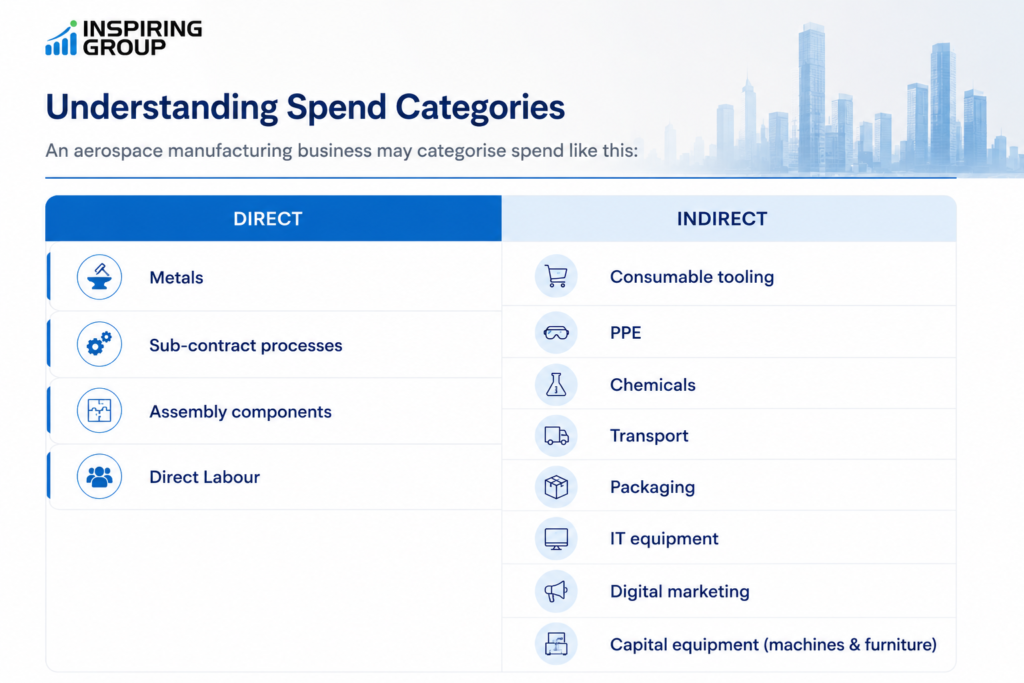
This level of visibility helps procurement teams identify specific areas that highlight key information, such as high spend, supplier dependency, and supply risk.
The Category Management Process
For a procurement category plan to be effective, it needs to follow a structured process. While every business may be different, most successful category management programmes include the following stages:
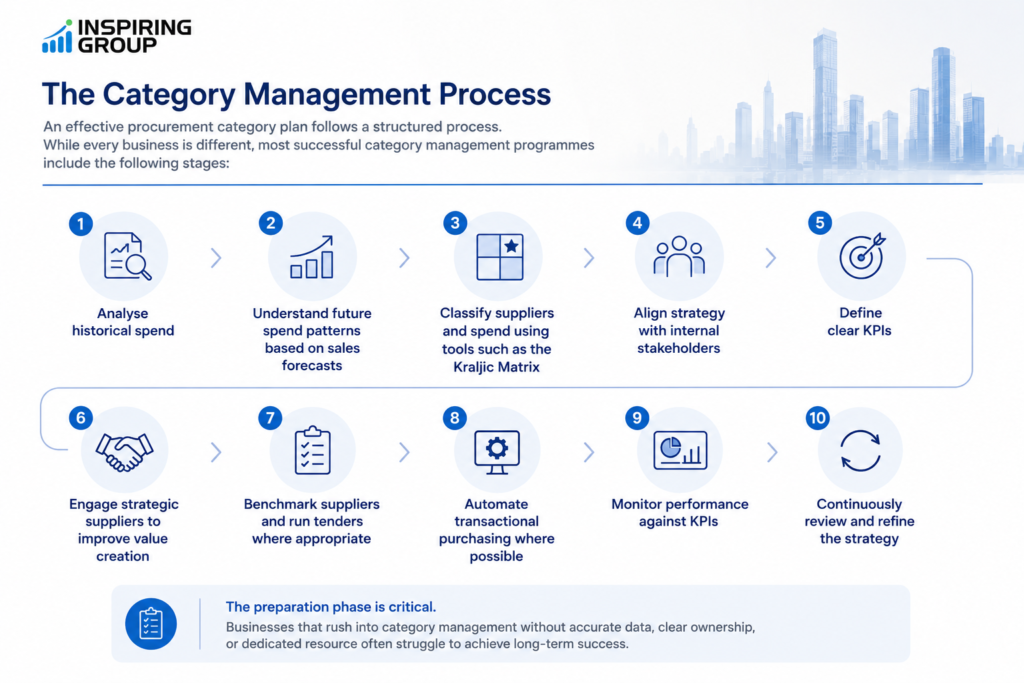
The preparation phase is crucial; businesses that tend to rush into category management without accurate data, clear ownership, or dedicated resources usually struggle to achieve success long-term.
What Makes an Effective Category Structure?
It is important to note that an effective category structure should support the wider goals of the company. Procurement should work alongside other departments within the business to help improve performance, support growth, reduce costs, and strengthen the supply chain. It is also important to understand the relationship with suppliers, as a supplier may be important to your business, but your business may not be a priority for them. Therefore, understanding this can help businesses manage supplier relationships more effectively and identify what improvements are needed.
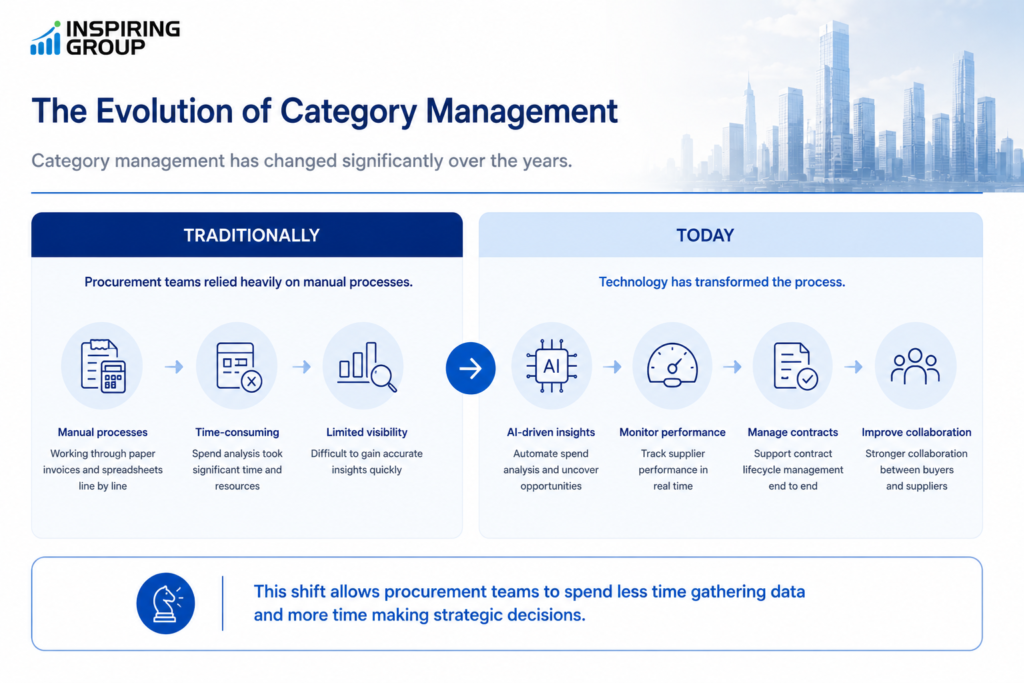
The Evolution of Category Management
Category management has changed significantly over the years.
Why Category Management Analysis Matters
There are many benefits to strong category management analysis; primarily, being to help make better buying decisions. Without clear information about suppliers and spending, it is much harder to keep costs down, check supplier performance, or spot risks. Supplier innovation is becoming very important, especially in advanced manufacturing industries, where many organisations rely on suppliers for technical expertise and product development support, and not just products.
Key benefits include:
- Identifying procurement and supply chain risks
- Reducing costs and improving efficiency
- Understanding spend patterns and purchasing trends
- Evaluating supplier performance
- Benchmarking against market conditions
- Supporting environmental and social responsibility goals
- Strengthening supplier collaboration and innovation
Procurement Risks Businesses Often Overlook
There are many risks businesses often overlook when it comes to procurement, and one of the most common mistakes is that companies treat procurement as purely transactional. In reality, suppliers are an extension of your organisation, and weak supplier performance can quickly impact quality, production, profitability, and customer satisfaction.
Businesses can also overlook risks further down the supply chain; for example, buying from a distributor in the UK may still expose the business to global supply chain disruption if that distributor sources materials internationally.
This is why category management and wider supply chain visibility are becoming more important across many industries and sectors.
The Key Stages of End-to-End Category Management
Successful end-to-end category management is built around continuous improvement rather than one-off cost reduction exercises.
1. Spend Analysis and Opportunity Identification
The first stage involves analysing current spend data, supplier relationships, and purchasing trends to identify opportunities for savings, consolidation, or risk reduction.
2. Building a Procurement Category Plan
Once opportunities are identified, businesses create a procurement category plan that outlines objectives, supplier strategies, timelines, and KPIs.
3. Category Strategy Implementation
This stage focuses on executing the agreed strategy, engaging suppliers, managing tenders, and tracking performance against objectives.
4. Continuous Improvement and Optimisation
Category management should never stand still. Markets change, supply chains evolve, and business priorities shift. Regular reviews help businesses adapt strategies and maintain long-term value.
Common Pain Points in Category Management
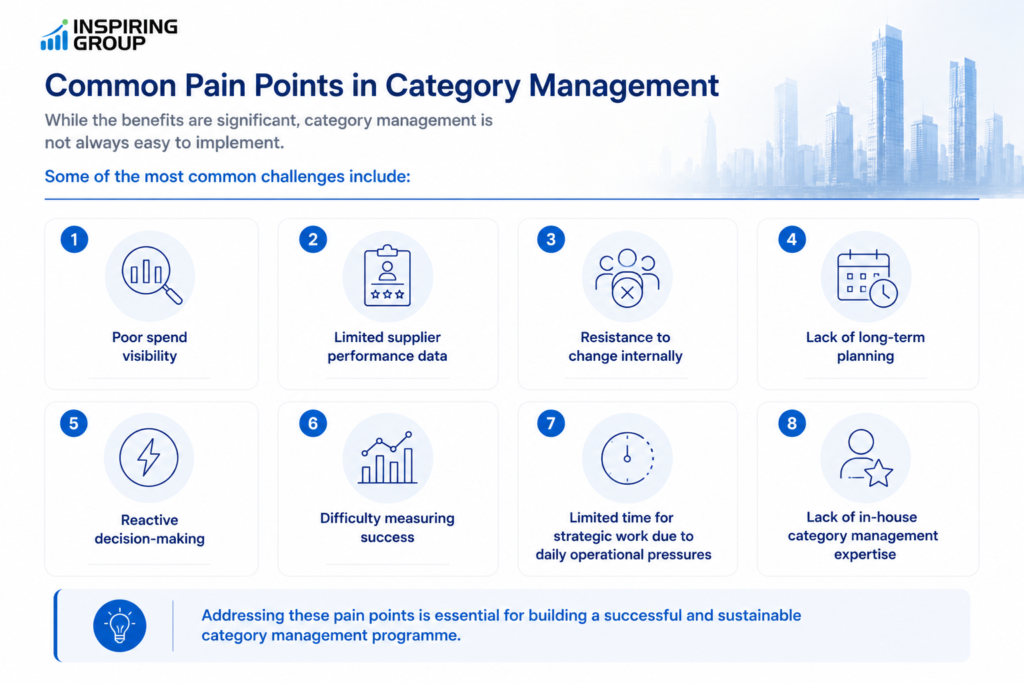
In many businesses, the procurement teams are stretched thin across operational responsibilities, leaving little time for proper strategic planning. This is where external expertise can provide great value by bringing dedicated focus, independent insight, and real experience.
How Inspiring Group Supports Category Management
Inspiring Group supports organisations by helping them develop structured, data-driven category management strategies that improve efficiency, reduce costs, and strengthen supply chains.
With experience across manufacturing industries, including aerospace, defence, automotive, nuclear, and power generation, the team understands the operational and commercial challenges businesses face.
From spend analysis and procurement category planning, through to supplier engagement and long-term optimisation, Inspiring Group helps businesses create sustainable procurement improvements that deliver measurable results.
Final Thoughts
Category management analysis is no longer just a procurement exercise. It is a strategic business function that helps organisations reduce costs, strengthen supplier relationships, improve resilience, and support long-term growth.
As procurement pressures continue to increase, businesses that take a proactive and data-driven approach to managing spend will be better positioned to create lasting value.
To see how Inspiring Group can help implement robust category management within your business, please get in touch for a chat or arrange a free initial consultation.