
Are You CBAM Ready?
CBAM: The Carbon Border Adjustment Mechanism is Coming into Force in January 2027 – What It Means for UK Businesses
From 1 January 2027, importing certain goods into the UK will become more expensive.
The UK’s new Carbon Border Adjustment Mechanism (CBAM) will introduce a carbon levy on imported goods such as aluminium, cement, fertiliser, hydrogen, and iron & steel. While the legislation is designed to create a fairer trading environment, its impact will extend far beyond heavy industry. Rising procurement costs, changing supplier relationships and greater scrutiny of carbon emissions are likely to affect businesses across manufacturing, engineering, construction, agriculture, infrastructure and many other sectors.
CBAM is far more than another environmental regulation. It represents a fundamental shift in how carbon emissions are priced within international trade, encouraging organisations to look beyond purchase price alone and consider the true carbon cost of the goods they buy. Businesses that understand these changes early will be better positioned to protect margins, strengthen supply chains and make more informed procurement decisions.
Whether you import carbon-intensive goods directly or purchase products from suppliers who do, CBAM has the potential to influence procurement strategies, project budgets and long-term commercial planning. Organisations that begin preparing now will be far better equipped to manage both the financial and operational impacts once the legislation comes into force.
In this guide, we’ll explain what CBAM is, why it’s being introduced, which sectors will be affected, how the compliance framework will operate, and most importantly, what procurement and business leaders should be doing today to prepare for January 2027.
What is the UK Emissions Trading Scheme (UK ETS)?
Before understanding CBAM, it’s useful to understand the UK Emissions Trading Scheme (UK ETS), as the two are closely linked.
The UK ETS is a cap-and-trade carbon market that places a financial value on carbon emissions produced by energy-intensive industries. Companies covered by the scheme must hold enough emissions allowances to cover every tonne of carbon dioxide (CO₂) they emit.
The system works by:
- Setting a cap on total emissions across participating sectors.
- Requiring businesses to hold emissions allowances for every tonne of CO₂ they produce.
- Allowing those allowances to be bought, sold and traded on the carbon market.
As the supply of allowances changes, so too does the market price of carbon. This creates a financial incentive for organisations to reduce emissions and invest in cleaner technologies.
Although the UK ETS and EU ETS now operate independently following Brexit, both schemes are based on the same core principle: putting a market price on carbon emissions to encourage decarbonisation.
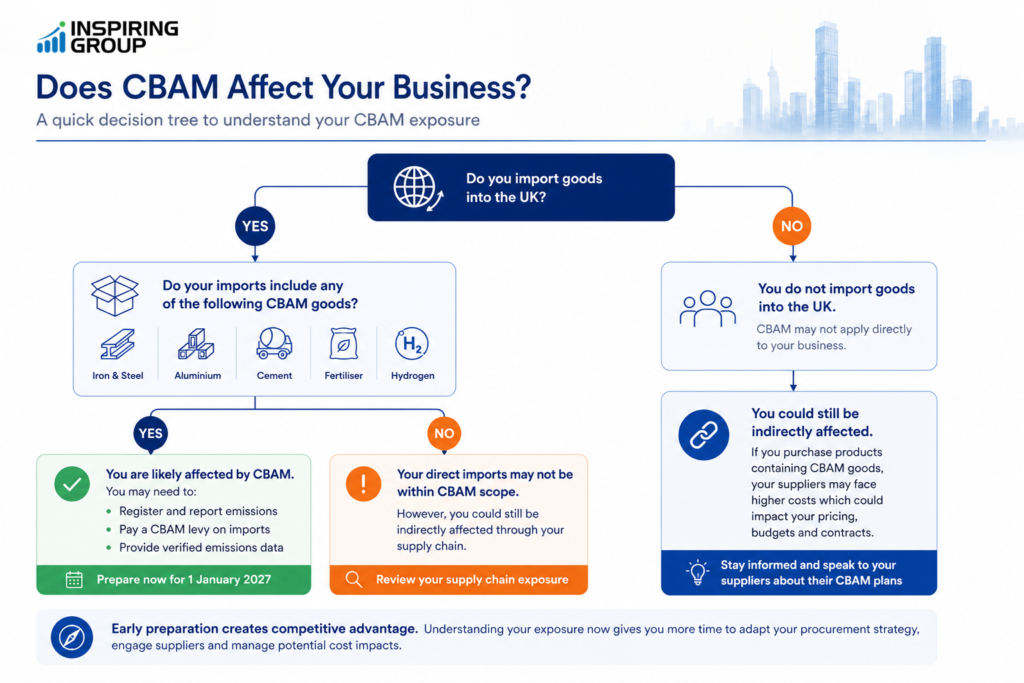
Does CBAM Affect Your Business?
Many organisations assume CBAM only applies to major importers or heavy industry. In reality, its impact is likely to be felt much further down the supply chain.
You should begin preparing now if your organisation:
- Imports aluminium, cement, fertiliser, hydrogen, iron or steel products into the UK.
- Purchases materials or products from suppliers that rely on imported carbon-intensive goods.
- Operates within manufacturing, engineering, construction, infrastructure, agriculture or facilities management.
- Is responsible for procurement, supplier management or commercial strategy.
- Is likely to experience increased material costs as suppliers pass on additional carbon charges.
Even if your organisation isn’t directly responsible for submitting CBAM returns, you may still experience rising costs, changes in supplier pricing, increased requests for emissions data and greater scrutiny of your procurement decisions.
For procurement leaders, finance teams and operational managers, CBAM should be viewed as a commercial issue rather than simply a compliance exercise. The earlier organisations understand their exposure, the greater opportunity they have to adapt sourcing strategies, negotiate with suppliers and protect long-term profitability.
Which Sectors and Products Are Impacted by CBAM?
The UK Government has deliberately limited the initial scope of CBAM to sectors considered both carbon-intensive and at high risk of carbon leakage.
From January 2027, the mechanism will apply to imported goods within five core sectors:
- Aluminium
- Cement
- Fertiliser
- Hydrogen
- Iron & Steel
Within each of these sectors, only specific products identified by commodity code will fall within the scope of the legislation.
The Government originally consulted on a wider range of industries, including glass and ceramics, but these sectors have not been included in the first phase. However, CBAM is expected to evolve, with further consultation already planned regarding additional products such as refined fuels and other carbon-intensive goods.
Although the list of directly affected products is relatively narrow, the commercial impact will extend much further.
For example, steel and aluminium are fundamental materials used across manufacturing, engineering, automotive production, machinery, infrastructure and construction. Increased costs at the point of import are therefore likely to ripple throughout entire supply chains as manufacturers and suppliers adjust their pricing models.
Similarly, fertiliser costs have the potential to affect agriculture, grounds maintenance, landscaping and food production, while cement prices could influence everything from commercial developments to public infrastructure projects.
Businesses should therefore avoid assuming they are unaffected simply because they do not import CBAM goods directly. Understanding where carbon-intensive materials enter your supply chain will become an increasingly important part of procurement and commercial planning as the legislation approaches.
How CBAM Works: Understanding the Compliance Framework
Although CBAM will have significant commercial implications, it is ultimately a compliance regime. Businesses importing affected goods will be responsible for understanding their obligations, gathering accurate emissions data and submitting the required information to HMRC.
The framework has been established through a combination of the Finance Act 2026 and supporting secondary legislation, which sets out how importers must register, calculate embedded emissions, verify information and determine any CBAM liability.
For many organisations, compliance will require closer collaboration between procurement, finance, sustainability and supply chain teams than ever before.
While the legislation is detailed, the overall process can be broken down into six key stages.
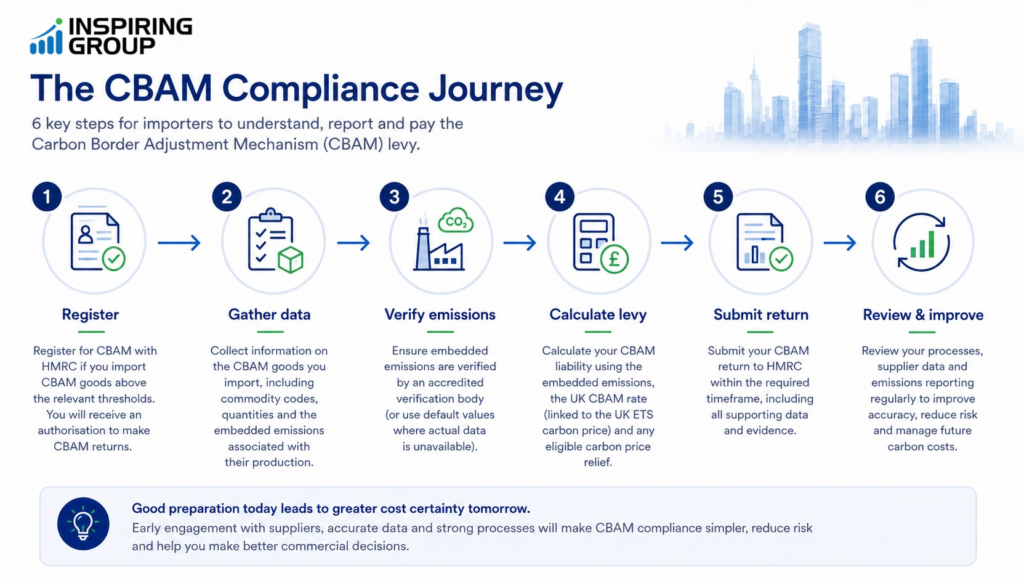
1. Registration and Returns
Businesses importing CBAM goods above the relevant thresholds will be required to register for the scheme and submit regular CBAM returns.
Each return must include detailed information about imported goods, including:
- The type of goods imported
- Commodity codes
- Import quantities and weights
- The embedded emissions associated with those goods
- Any carbon price already paid in the country of origin
Maintaining accurate records will become an essential part of the procurement process. Organisations that currently have limited visibility of supplier emissions data may need to introduce new reporting procedures and work more closely with overseas suppliers.
2. Calculating Embedded Emissions
One of the most significant changes introduced by CBAM is the requirement to calculate the embedded emissions associated with imported goods.
Embedded emissions represent the greenhouse gases produced during manufacturing before a product reaches the UK.
The methodology for calculating these emissions is set out within the CBAM (Emissions and Verification) Regulations 2026, ensuring businesses use a consistent approach when determining carbon intensity.
Importers will generally be able to use one of two approaches:
Actual Emissions
Where available, businesses should use verified emissions data provided by the manufacturer.
This provides the most accurate representation of a product’s carbon footprint and may reduce the overall CBAM liability where suppliers operate low-carbon production facilities.
Default Values
Where verified emissions data cannot be obtained, Government-issued default emissions values may be used.
However, default values may not accurately reflect an individual manufacturer’s performance and could result in a higher carbon liability than using verified data.
For this reason, organisations should begin discussing emissions reporting with suppliers well before January 2027.
3. Verification Requirements
Accuracy sits at the heart of the CBAM framework.
To maintain confidence in reported emissions, overseas manufacturers may need to have their emissions independently verified by accredited verification bodies before importers can rely on the data.
Verification helps ensure:
- Emissions calculations are accurate.
- Reporting methodologies are consistent.
- Carbon reduction claims can be substantiated.
- Businesses cannot artificially reduce reported emissions.
As demand for verified emissions data increases, organisations with established supplier relationships are likely to find collaboration significantly easier than those beginning these conversations at the last minute.
4. Understanding the CBAM Levy
One common misconception is that CBAM applies a fixed tax to imported goods.
In reality, the levy is dynamic.
The amount payable will depend on several factors, including:
- The embedded emissions within the imported product.
- The prevailing UK ETS carbon price.
- Any recognised carbon price already paid overseas.
This approach ensures imported goods face a carbon cost broadly equivalent to that paid by UK manufacturers while avoiding unnecessary double charging where equivalent carbon pricing already exists.
As the UK ETS carbon price changes over time, so too will the CBAM levy.
This means businesses should consider CBAM as an ongoing commercial variable rather than a one-off compliance exercise.
5. Carbon Price Relief
The legislation recognises that many countries already operate their own carbon pricing mechanisms.
Where importers can demonstrate that an equivalent carbon price has already been paid during production, they may be eligible for carbon price relief.
The Calculation of CBAM Rate and Determination of Carbon Price Relief Regulations 2026 establish how this relief is calculated, including:
- The carbon pricing mechanisms that qualify.
- Currency conversion methodologies.
- Evidence required to support relief claims.
- Verification requirements.
This is an important safeguard within the legislation, ensuring businesses are not unfairly charged twice for the same emissions.
However, claiming relief will depend on having sufficient documentation, reinforcing the importance of strong supplier engagement and accurate record keeping.
6. Compliance Is More Than a Reporting Exercise
For many organisations, CBAM will initially appear to be another reporting obligation.
In reality, it represents something much broader.
Businesses will need to understand where carbon-intensive goods enter their supply chains, evaluate supplier emissions data, monitor changing carbon costs and incorporate these considerations into procurement and commercial decision-making.
For procurement teams, this marks a significant evolution in supplier management.
Historically, supplier evaluation has focused on cost, quality, delivery performance and risk.
Going forward, carbon transparency, emissions reporting capability and environmental performance are likely to become increasingly important criteria when selecting and managing suppliers.
Organisations that invest in robust reporting processes today will not only find compliance easier, but will also be better positioned to respond as carbon reporting becomes a more prominent feature of international trade.
Why CBAM Matters for UK Businesses
Although CBAM directly targets a relatively small number of imported products, its commercial impact will extend far beyond the organisations responsible for paying the levy.
As suppliers absorb additional carbon costs, many will inevitably pass these increases through their pricing structures. This means businesses throughout the supply chain are likely to experience higher procurement costs, increased pressure to understand supplier emissions and greater scrutiny of sourcing decisions.
For procurement professionals, the challenge is no longer simply complying with legislation. It is understanding how these changes influence supplier relationships, long-term contracts, capital investment decisions and overall commercial strategy.
This is where strong category management becomes increasingly valuable, allowing procurement teams to work more closely with strategic suppliers to improve visibility and reporting.
Why Preparation Matters
Many organisations will view CBAM as another compliance requirement. Forward-thinking businesses will see it as an opportunity to strengthen procurement, improve supplier visibility and build more resilient supply chains.
By preparing early, organisations can:
- Improve supplier engagement and emissions transparency.
- Reduce the risk of unexpected cost increases.
- Strengthen procurement and commercial planning.
- Build greater resilience into their supply chains.
- Stay ahead of future environmental regulation.
The businesses that start planning today will have more flexibility, stronger supplier relationships and a clearer understanding of their commercial exposure before CBAM comes into force.
How Inspiring Group Can Help
Preparing for CBAM requires more than understanding legislation. It requires practical procurement expertise, supplier engagement and commercial planning.
At Inspiring Group, we help organisations:
- Assess their exposure to CBAM.
- Review supplier readiness and procurement risks.
- Build practical compliance frameworks.
- Strengthen procurement strategies and governance.
- Turn regulatory change into a commercial opportunity.
Whether you’re looking to understand your exposure or prepare your organisation for January 2027, our team can help you navigate procurement transformation with confidence.
Get in touch to discuss how CBAM could impact your organisation and how we can help you prepare.